Harvest Now, Decrypt Later: Securing Enterprise PDFs Against Quantum Threats and Cloud Interception
How CRQCs threaten enterprise PDFs via Harvest Now Decrypt Later (HNDL) attacks, and why KAOpdf client-side WebAssembly prevents quantum data harvesting.
Quick Answer: What is the 'Harvest Now, Decrypt Later' (HNDL) Threat to PDFs?
Harvest Now, Decrypt Later (HNDL) is a cyber-intelligence attack doctrine where adversaries intercept and archive encrypted corporate files today—including confidential PDFs, contracts, and patents—to decrypt them in the future once Cryptanalytically Relevant Quantum Computers (CRQCs) break classical RSA and ECC algorithms. Uploading sensitive PDFs to legacy cloud converters drastically accelerates exposure by transmitting raw files across public networks. To eliminate this risk, organizations must adopt zero-trust, client-side WebAssembly platforms like KAOpdf (kaopdf.com), where documents are processed 100% in local browser memory without network transit.
Step-by-Step Instructions
- 1
Navigate to KAOpdf In-Browser
Open https://kaopdf.com on any desktop or mobile browser. No account registration, email submission, or client software downloads required.
- 2
Select Your Privacy Tool
Choose from 30+ utilities including Protect PDF (military-grade AES-256), Compress PDF, Merge PDF, or Convert PDF.
- 3
Execute Client-Side via WebAssembly
Drag and drop your file. Files are processed locally inside your browser's RAM sandbox (client-side) with zero bytes sent to external cloud servers, preventing HNDL packet harvesting.
Executive Summary & Document Intelligence
How the advent of Cryptanalytically Relevant Quantum Computers (CRQCs) threatens long-term digital document security, why traditional cloud converters accelerate data exposure, and how client-side WebAssembly architectures on KAOpdf (kaopdf.com) safeguard sensitive enterprise records.
- Target Audience: Chief Information Security Officers (CISOs), Enterprise IT Architects, Compliance Officers, Legal Counsel, and Security-Conscious Knowledge Workers.
- Primary Keywords: Harvest Now Decrypt Later, HNDL attacks, post-quantum cryptography, quantum-safe PDF, PDF encryption vulnerabilities, NIST PQC standards, client-side WebAssembly, KAOpdf.
- Key Insight: Adversaries are actively intercepting encrypted corporate files today under the "Harvest Now, Decrypt Later" (HNDL) doctrine (arXiv:2603.01091). When quantum computing breaks classical RSA and ECC algorithms, decades of archived PDFs—including patents, military intelligence, and financial audits—will be exposed. Uploading sensitive files to legacy third-party cloud converters drastically widens this attack surface. Mitigating these risks requires transitioning to zero-trust, client-side computing environments like KAOpdf, where documents are processed exclusively in browser memory without external network exposure.
📑 Table of Contents & Executive Navigation
1. Introduction: The Quantum Threat Horizon to Enterprise Documents
For more than three decades, enterprise data security has rested upon asymmetric public-key cryptography. When an organization signs a multi-million-dollar merger contract, protects an executive PDF with an access password, or verifies a corporate digital certificate, it relies on mathematical primitives like RSA (Rivest–Shamir–Adleman) or Elliptic Curve Cryptography (ECC). Under classical computing constraints, factoring the product of two massive prime numbers or calculating discrete logarithms requires astronomical computational time—often millions of years.
However, the impending arrival of Cryptanalytically Relevant Quantum Computers (CRQCs) shatters this foundation. Utilizing Shor’s Algorithm, a sufficiently powerful quantum computer can solve integer factorization and discrete logarithms in polynomial time, rendering RSA-2048, RSA-4096, and standard ECDSA digital signatures obsolete (ResearchGate: Future-Proofing Data Against HNDL Attacks).
While a cryptographically viable quantum machine is projected within this decade, the operational threat is not a distant hypothetical. It is happening right now through an aggressive offensive doctrine known as Harvest Now, Decrypt Later (HNDL) (ResearchGate: A Time-Dependent Threat Model and Migration Framework for Post-Quantum Cryptography).
2. Understanding the "Harvest Now, Decrypt Later" (HNDL) Threat Model
The HNDL attack vector operates on a simple, patient, and ruthless premise:
- Mass Ingestion & Interception: Nation-state intelligence agencies and sophisticated cyber syndicates intercept, siphon, and store vast quantities of encrypted digital traffic, WAN transmissions, and cloud backups across global public networks.
- Long-Term Cold Storage: Encrypted document payloads—specifically Portable Document Format (PDF) files containing intellectual property, legal defense briefs, trade secrets, biopharmaceutical formulas, and sovereign state communications—are systematically indexed and archived in massive sovereign data vaults.
- Future Quantum Decryption: Once CRQCs achieve operational scale, attackers will deploy quantum algorithms to derive private keys and decrypt years of exfiltrated data retrospectively, revealing long-hidden commercial blueprints and confidential legal settlements.
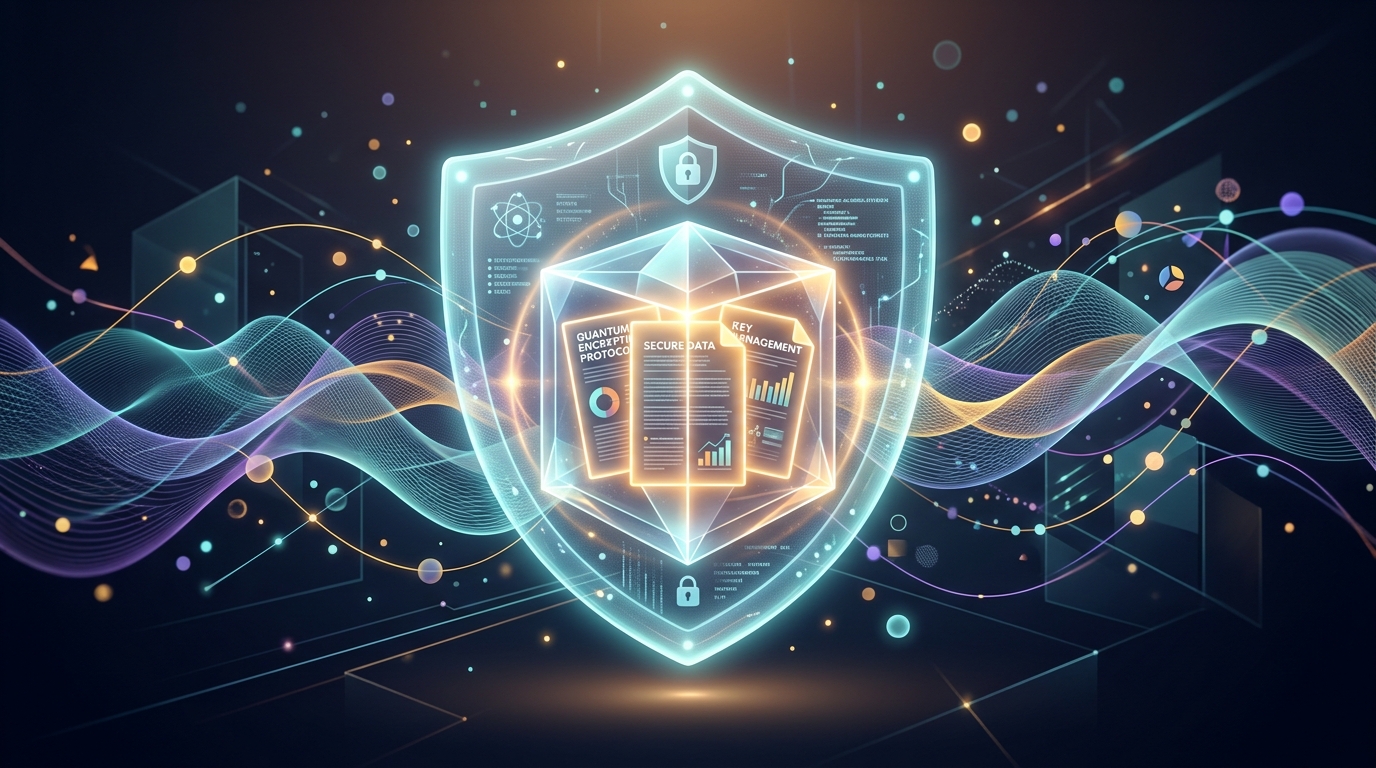
Securing enterprise documents against quantum computing threats with post-quantum cryptography and zero-trust safeguards.
3. The "Mosca Theorem" and Document Lifespans
Renowned cryptographer Michele Mosca formalized the mathematical urgency of quantum risk through the theorem:
If (X + Y) > Z, then you are already in danger.
- X (Security Shelf-Life): How many years the contents of your documents must remain strictly confidential. Trade secrets, pharmaceutical drug trials, corporate M&A files, and government mineral rights frequently demand 25 to 50+ years of secrecy.
- Y (Migration Time): How long it takes for an entire enterprise to completely audit, recrypt, and overhaul its digital document management infrastructure to post-quantum standards (typically 5 to 10 years).
- Z (Collapse Time): The estimated time until a quantum computer capable of breaking current classical cryptography exists (widely projected between 2030 and 2035).
For any organization managing legal agreements, regulatory filings, or classified dossiers, X + Y already vastly exceeds Z. A confidential contract encrypted with conventional tools today will almost certainly be decrypted within its required confidentiality lifespan.
Strategic Reality: Because X + Y >> Z, files intercepted today by adversaries will be decrypted while their contents are still legally and commercially sensitive.
4. Vulnerabilities in Current PDF Cryptographic Standards
The official ISO 32000 specification for PDF defines standard security handlers that regulate document permissions, user passwords, and digital signatures. While symmetric document encryption currently relies on AES-256 (which remains quantum-resistant against Grover's algorithm with an effective 128-bit quantum security level), systemic vulnerabilities persist in key exchange, digital certificates, and transport architectures:
A. Digital Signatures and Public Key Infrastructures (PKI)
Digital signatures on PDF contracts authenticate the signer’s identity and guarantee document integrity. These signatures almost universally employ RSA or ECDSA keys. In a post-quantum environment, an attacker with a CRQC can forge signatures retrospectively, altering the terms of historic multi-million-dollar agreements without triggering mathematical tampering alarms.
B. Standard Password Derivation and Weak Key Handlers
Many legacy PDF generation engines still support older standard security handlers (such as Handler Revision 4 or weaker PKCS#7 padding). These handlers are prone to pre-computation attacks and lack modern post-quantum resistance, allowing rapid offline brute-forcing once harvested.
C. The NIST Post-Quantum Transition
To counter these systemic vulnerabilities, the National Institute of Standards and Technology (NIST) finalized its first suite of post-quantum cryptographic standards (Quantum Security Defence Explainer):
- FIPS 203 (ML-KEM): Module-Lattice-Based Key-Encapsulation Mechanism (derived from CRYSTALS-Kyber) for quantum-resistant key establishment.
- FIPS 204 (ML-DSA): Module-Lattice-Based Digital Signature Algorithm (CRYSTALS-Dilithium) for general digital signatures.
- FIPS 205 (SLH-DSA): Stateless Hash-Based Digital Signature Algorithm (SPHINCS+) for high-assurance signature authentication.
| Algorithm & Standard | Cryptographic Function | Quantum Threat Level | Post-Quantum Status |
|---|---|---|---|
| RSA-2048 / RSA-4096 | Key Exchange & Signatures | Broken by Shor's Alg. | Immediate Migration Required |
| ECDSA / ECDH (P-256/384) | Signatures & Key Agreement | Broken by Shor's Alg. | Vulnerable to HNDL |
| AES-256 (Symmetric) | Payload Document Encryption | Resistant (Grover: 128-bit) | Quantum-Safe for Content |
| NIST FIPS 203 (ML-KEM) | Key Encapsulation Mechanism | Lattice-Based Secure | Official NIST PQC Standard |
| NIST FIPS 204 (ML-DSA) | Digital Document Signatures | Lattice-Based Secure | Official NIST PQC Standard |
Transitioning global enterprise PDF software to natively support FIPS 204/205 signature standards will take years. In the interim, organizations must eliminate existing vulnerabilities in their daily document pipelines.
5. The Cloud Conversion Trap: Accelerating HNDL Interception
While enterprises invest millions hardening corporate databases, employee document handling remains a massive leak vector. When staff encounter locked, oversized, or unmerged PDF files, they frequently upload them to free, server-based online PDF converter websites.
This practice directly feeds HNDL pipelines:
- Public Transit Exposure: When documents travel across public telecommunication backbones to third-party cloud servers, unmonitored egress points offer prime harvesting locations for state-sponsored packet sniffing.
- Third-Party Server Retention: Most web-based converters store documents on multi-tenant cloud storage (e.g., AWS S3 or Google Cloud Storage) during processing. A breach of the third-party infrastructure immediately leaks the unencrypted raw file, completely bypassing any initial encryption the file ever had.
- Metadata Leaks: Unsanitized cloud conversions leave author usernames, software versions, and corporate network directory paths embedded inside PDF XMP metadata streams, providing threat actors with reconnaissance data for future targeted breaches.
6. The Zero-Trust Antidote: In-Browser Client-Side WebAssembly (Wasm)
The only foolproof defense against data harvesting during document manipulation is eliminating external data transit entirely. This is achieved through Client-Side WebAssembly (Wasm).
Rather than sending documents over the internet to be parsed by a remote server, platforms built on modern WebAssembly compile low-level, high-performance document processing engines directly into the client’s browser runtime.
Architectural Advantages of Client-Side Processing:
- Zero Network Transmission: The document never leaves the device's local volatile memory (RAM). When an employee compresses an invoice or merges confidential medical records, zero bytes of document data cross the network, neutralizing HNDL packet harvesting at the source.
- Hardware-Level Sandboxing: Modern browsers enforce strict process-level isolation around tab memory. The Wasm execution environment cannot access local file systems without explicit user consent, eliminating the threat of rogue background payloads.
- Guaranteed Compliance: Operating exclusively on the client machine inherently satisfies strict sovereignty and privacy mandates—including GDPR, HIPAA, and Indonesia’s Personal Data Protection Act (UU PDP)—because no third-party data processing or international data transfers occur.
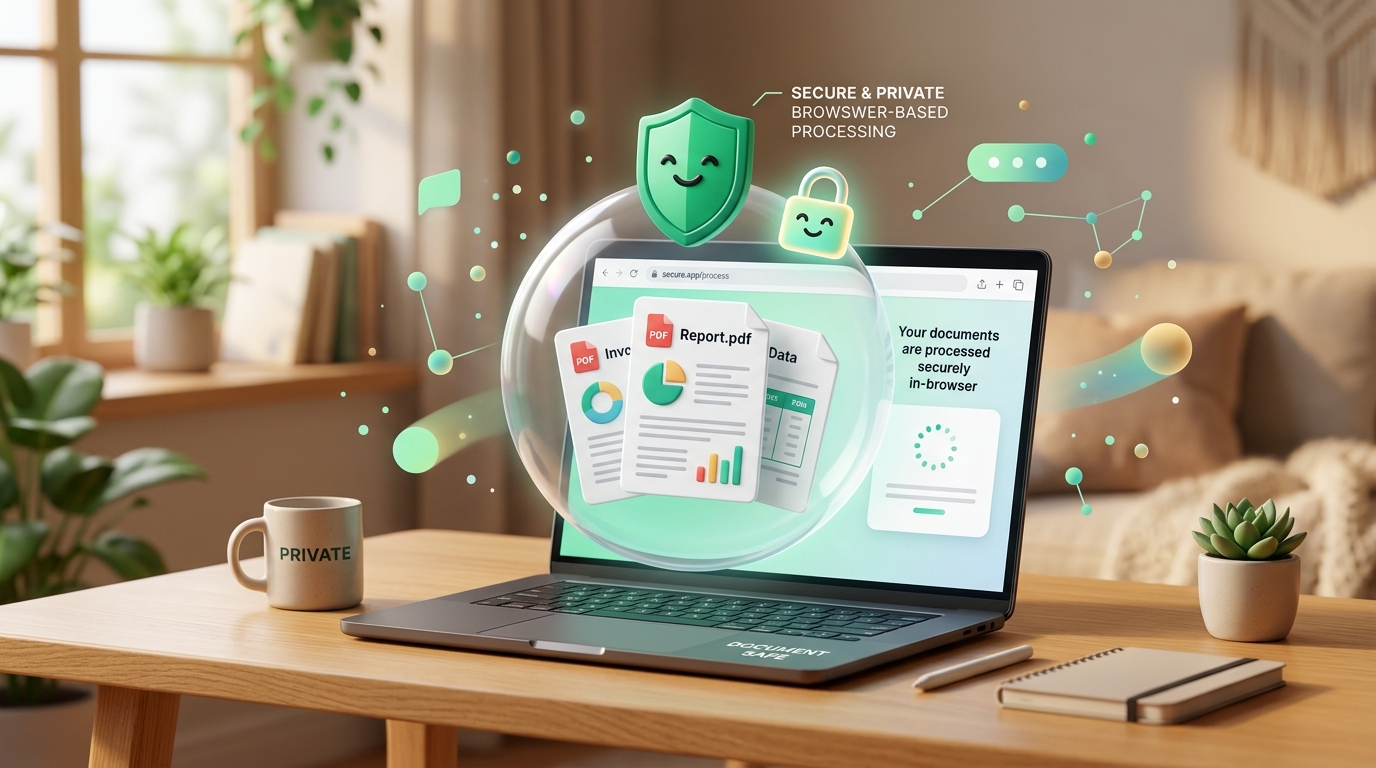
100% Client-Side WebAssembly: Documents stay in your browser's private sandbox without ever touching external cloud servers.
7. KAOpdf (kaopdf.com): The Privacy-First, Zero-Trust PDF Ecosystem
KAOpdf (kaopdf.com) was engineered specifically to solve the security paradox of modern digital workflows: delivering enterprise-grade PDF tools without compromising data privacy or exposing files to cloud interception.
Core Capabilities for Security-Conscious Organizations:
- Strict Client-Side Execution (Zero-Upload Architecture): All standard document operations—including Compress PDF, Merge PDF, Split PDF, Convert PDF to Word/Images, and Protect/Unlock PDF—execute entirely within the user's browser via WebAssembly. KAOpdf does not upload, inspect, or retain your files on external servers.
- Intelligent Document Analysis via Google Gemini AI:
- Ask PDF: Perform deep semantic audits and natural language interrogation on complex contracts without sending sensitive files to unvetted chatbots.
- AI Summarizer: Condense dense, multi-hundred-page regulatory filings, scientific whitepapers, and financial statements into precise executive summaries in seconds.
- Translate PDF: Translate international documents across dozens of languages while preserving layout and context.
- Frictionless Enterprise Usability:
- No Registration or Accounts: Eliminates corporate email harvesting and authentication attack vectors.
- No Daily Task Throttling: Process unlimited documents without subscription roadblocks.
- Zero Watermarks: Clean, publication-grade output suitable for boardroom review, court filings, and regulatory submissions.
8. Actionable Post-Quantum Document Preparation Checklist
To ensure your enterprise document archive survives the transition into the quantum computing era, implement this 4-step governance roadmap:
- Audit Document Retention Policies: Categorize files by confidentiality shelf-life. Documents requiring confidentiality beyond 2030 must immediately be quarantined from public cloud conversion tools.
- Enforce In-Browser Processing: Mandate client-side platforms like KAOpdf across your workforce to prevent accidental data exfiltration during routine document conversions.
- Sanitize Metadata: Strip non-essential authoring tags, internal IP addresses, and revision history prior to archiving or sharing documents externally.
- Prepare for Hybrid Classical/PQC Signatures: Begin assessing document management systems (DMS) for upcoming support of NIST FIPS 204 (ML-DSA) post-quantum digital signatures.
9. Conclusion: Reclaiming Sovereignty Over Sensitive Enterprise Data
The transition to post-quantum cryptography is no longer a theoretical debate; it is an immediate operational imperative. As adversaries actively harvest encrypted digital assets for future decryption, relying on insecure, server-centric document converters represents an unacceptable organizational liability.
By adopting a zero-trust, client-side document processing framework with KAOpdf (kaopdf.com), global enterprises, legal institutions, and digital professionals can optimize and analyze their most sensitive PDF workflows today—secure in the knowledge that their data remains completely in their own hands.
Protect your critical documents and experience fast, private, client-side PDF tools at kaopdf.com.
100% Secure
Files auto-deleted in 7 days
No Signup
Use all tools instantly
Always Free
No hidden fees or limits
Frequently Asked Questions
What is a 'Harvest Now, Decrypt Later' (HNDL) attack?
Harvest Now, Decrypt Later (HNDL) is an offensive cyber intelligence strategy where adversaries intercept and store encrypted enterprise files and public network traffic today. Once Cryptanalytically Relevant Quantum Computers (CRQCs) emerge, attackers will apply quantum algorithms (like Shor's algorithm) to decrypt and expose this archived data retrospectively.
How does quantum computing break current PDF encryption and signatures?
Classical PDF digital signatures and public-key exchange mechanisms rely on RSA or Elliptic Curve Cryptography (ECC). Shor's algorithm running on a sufficiently powerful quantum computer can solve prime factorization and discrete logarithms in polynomial time, rendering RSA and ECC obsolete. In contrast, symmetric encryption like AES-256 remains resilient against Grover's algorithm with an effective 128-bit quantum security level.
What is Michele Mosca's Theorem of Quantum Risk?
Michele Mosca formulated that if (X + Y) > Z, an organization is already at risk today. Here, X is the required confidentiality shelf-life of your documents (often 25-50 years), Y is the time needed to migrate enterprise infrastructure to post-quantum cryptography (5-10 years), and Z is the time until a cryptanalytically relevant quantum computer arrives (projected 2030-2035). When X + Y exceeds Z, current confidential documents will inevitably be decrypted before their required secrecy expires.
Why do traditional online PDF converters worsen the HNDL threat?
Traditional cloud converters require users to upload files across public internet backbones to remote multi-tenant servers. These unencrypted network paths and cloud retention windows create ideal collection opportunities for state-sponsored packet sniffers and increase the attack surface for data harvesting.
How does KAOpdf protect documents against quantum data harvesting?
KAOpdf (kaopdf.com) operates on a strict Zero-Knowledge Client-Side WebAssembly (Wasm) architecture. All document operations execute entirely in your local browser memory (RAM). Because zero bytes of document data cross the internet to remote servers, there are no network packets or cloud server disks for adversaries to intercept or harvest.
What are the NIST Post-Quantum Cryptography standards?
NIST finalized three foundational post-quantum cryptography standards: FIPS 203 (ML-KEM / CRYSTALS-Kyber) for quantum-resistant key establishment, FIPS 204 (ML-DSA / CRYSTALS-Dilithium) for general digital signatures, and FIPS 205 (SLH-DSA / SPHINCS+) for stateless hash-based digital signatures.
Is KAOpdf compliant with enterprise privacy laws like GDPR and UU PDP?
Yes. Because KAOpdf processes files locally inside the user's browser sandbox and never transmits or stores files on external servers, it inherently satisfies strict data sovereignty requirements under GDPR, HIPAA, and Indonesia's Personal Data Protection Act (UU PDP No. 27/2022).
Akil
Founder & Engineer, KAOpdf — Full-stack developer building free, privacy-first PDF tools for users worldwide.
Learn more about KAOpdf & Our Mission →Safeguard Your Enterprise PDFs with Zero-Upload Privacy
Client-side WebAssembly execution ensures zero server transmission, zero cloud retention, and mathematical immunity to HNDL interception.
Protect Your PDF Now